Grantmakers in the Arts interviewed me for their podcast series. On this podcast, I talked about doing research, data strategy, architecting knowledge systems, the power of community-driven data collection, building learning communities among arts researchers and administrators, the importance of raising shared inquiries among arts funders, blah blah blah. And my transition from academic ethnomusicology and digital humanities to public-and-cultural-sector work.
Thanks to Grantmakers in the Arts for inviting me!
A little while ago, I was awarded with a flash grant from Shuttleworth Foundation, thanks to Shuttleworth fellow Sean Bonner for his nomination. If you’re unfamiliar with Shuttleworth, it’s a neat foundation with a mission to create “an open knowledge society with limitless possibilities” through funding projects that embody the ethos of openness.
As a believer, thinker, and doer of open knowledge, Shuttleworth’s progressive message hits me close to home. This flash grant affirms my sharing of what I do while I am doing it, a work style that I’ve come to develop over the years. This openness challenges the competitive norms of this society, a world organized by individualism, meritocracy, and institutional forms of privatization and policy protectionism. In academia and the art/music world, I have learned and unlearned many lessons regarding the social consequences of knowledge production and dissemination.
To me, knowledge production has to be checked with social reality of what it does to our community. How do we talk about what we know? Who do we learn from? Who has access to this knowledge? Who is entitled to this knowledge? With whom should we share our learnings? Who benefits from this knowledge? Who is harmed by this knowledge? Which institutional and economic contexts support (or regulate) the production of knowledge? (I’ve talked about some of these concerns in the context of open access publishing and ethnomusicology previously.)
These are complex questions (and many folks including Deb Verhoeven, Kimberly Christen, and Michelle Kisliuk have spent lots of time thinking about this). The idea of openness itself is further complicated by the fact that there are multiple publics in the society, some weak, some strong. These questions form an ethical compass throughout all of my professional and creative endeavors. Because there are political and economical concerns tied to all knowledge production and dissemination, we should consider each context thoughtfully.
Last month, I completed a two-year fellowship. The ACLS Public Fellowship was a tremendous opportunity in which I learned my ways as a public-sector researcher and digital strategist during my time at the City of Los Angeles Department of Cultural Affairs. The Shuttleworth grant came at a good time to help support my post-fellowship work in a few community sound projects that I’ve put on the back burner. Specifically the grant is supporting my time and labor while I make progress to deepen my sound-based research and creative engagement to re-make the public sphere in Los Angeles, a city that I came to adore and care for.
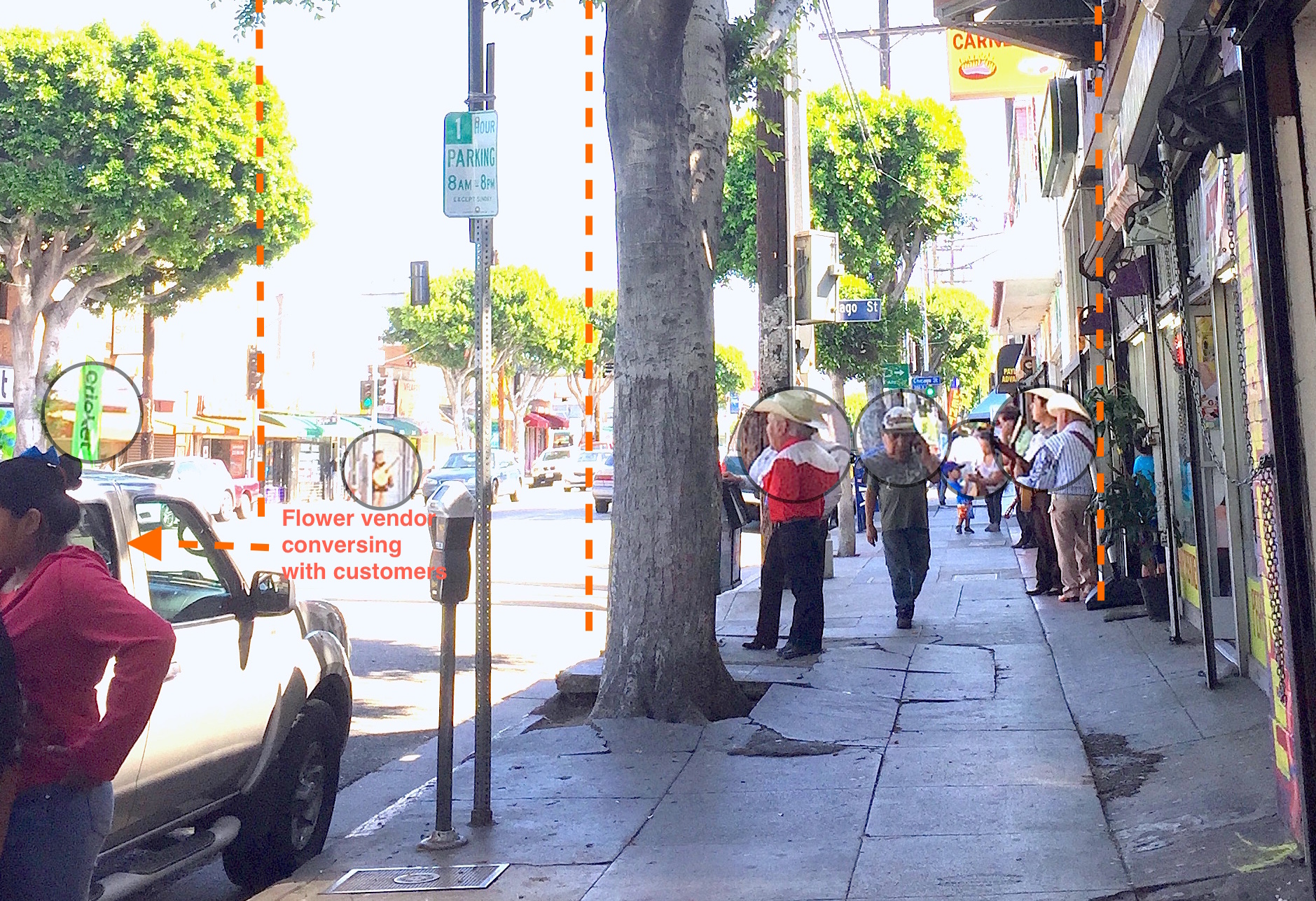
I’m making progress in LA Listens, a collaborative project that explores sounds of urban vibrancy in Los Angeles. In the last year, we developed a community-based methodology to engage with the social, ecological and experiential dimensions of the soundscape of city streets. Our methodology has contributed to the creative re-imagining of the acoustic public of particular locales and broader civic discussions about the role of sound in neighborhood changes and urban planning policy. Through a collaboration with MIT’s Community Innovators Lab (CoLab), We have shared research narratives including sound compositions based on our data have spurred a series of sound walks, location recordings, and sound-based provocations among urban planners and organizers in cities worldwide (summarized in this CityLab article by the Atlantic). I’m using my time to explore possible community partnerships and share our project reflection as blog posts and possibly a journal article. I’m also excited about funding a research internship for the project. Rounak Maiti, a former student from Occidental College, has joined the team to assist with field recording analysis and re-composition.
Soundwalk in Boyle Heights neighborhood, Los Angeles
I have remobilized the Movable Parts team (a socially concerned maker collective) to produce a creative intervention regarding the collective mobility experience in LA. With a microgrant from Metro, we built a prototype for Movable Karaoke, a participatory multilingual system on a pedicab. During California Rideshare Week, we staged a series of karaoke events through the streets and at transit hubs such as metro stations, bus stops, sidewalk, parklets and plazas (documented on instagram). Residents and passersby in Koreatown, East Hollywood, Thai Town, Hollywood, Chinatown, and Pershing Square came to us, with adults sharing personally meaningful songs, children trotting along on the sidewalk and in the schoolyard. In the coming weeks, I plan to share my thoughts on rickshaw design along with some stories and experiences of collective mobility.
Movable Karaoke, Chinatown
Working with fellow sound ethnomusicologist Yun Emily Wang, I’m co-designing a sound installation that will be included as a part of an exhibition at the upcoming Society of Ethnomuisoclogy meeting in Austin, Texas. This collaborative project will explore the meaning of “雜 (dza) through materializing the mixed, blended, miscellaneous, and insignificant odds and ends of sounds in Taiwan.” This coming Wednesday, I will be recording a live video set with my ghost pop band Bitter Party for the Ear Meal Webcast series. This performance will feature field recordings collected from recent trips to Taiwan, adding a new context to the band’s ethnographically driven song arrangement.
Concept drawings for Dza, a sound installation for SEM
Labor and time are the building blocks in our creative economy. I give a shout out to Shuttleworth for playing a critical role in supporting me through this highly creative period, and for sustaining our broader creative ecology. Honored and thankful, I will continually share what I do in these exciting projects in the near future.
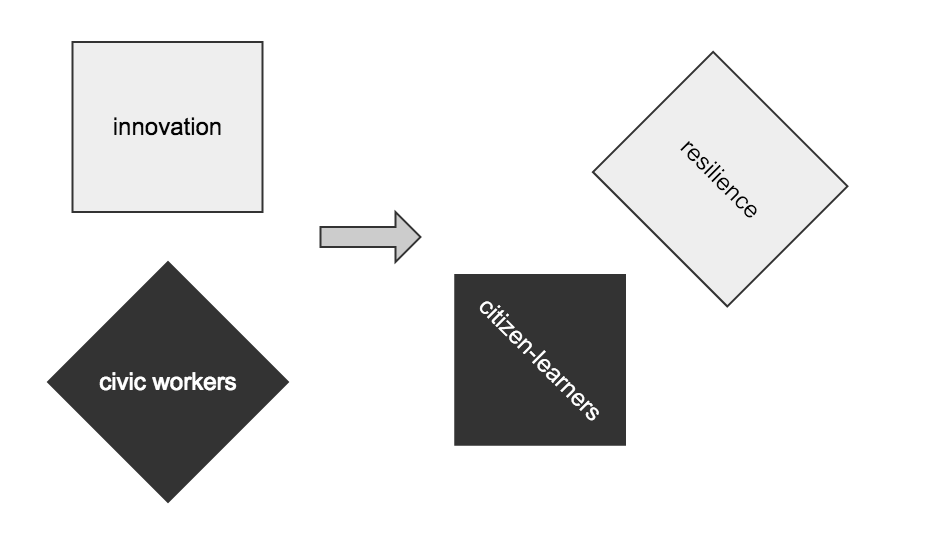
Last week, I gave a keynote talk about enacting humanist possibilities at Re:Humanities, a undergraduate conference organized by Tri-Co DH (Swarthmore, Bryn Mawr, and Haverford College). In this paper, I raise the question: how do we as humanists translate humanist critiques into actionable insights? I cite Rita Felski’s list of the problems of cultural critiques — noting that critique is, by design, negative, slow, past-oriented, and produced for a small audience who produce critiques. Seeing the inactionability of cultural critiques, I advocate for a two-part process, using the musical analogy of a call and response, to transform critiques into practice.
I employ the principles of “contact -> pivot -> prototype” to suggest a new framework. I illustrate this model by discussing our design process used in the Paperphone project. I also contend for the practice of humanities-inspired speculative design (while citing Dunn and Raby’s book Speculative Everything). My talk ends with close look at my current work at an ACLS Public Fellow with the City of Los Angeles Department of Cultural Affairs, researching and designing for a more human(ist) government.
My slides are below. If you would like to see my notes, click on the little gear icon to “open speaker notes.”
Additionally, I’m working on a short essay (for an edited volume) that will refine and develop some of these ideas. The goal is to come up with a model for civic digital humanities and contribute to the larger conversation about the continuum between digital and public humanities. So any feedback is welcome!
I did a mini-residency at RMIT University in Melbourne a few weeks ago. The generous folks of the Digital Ethnography Research Center invited me to give a talk + workshop on my research related to digital ethnography. I wrote up this description of my talk + workshop entitled “Digital Ethnography Design Workshop”:
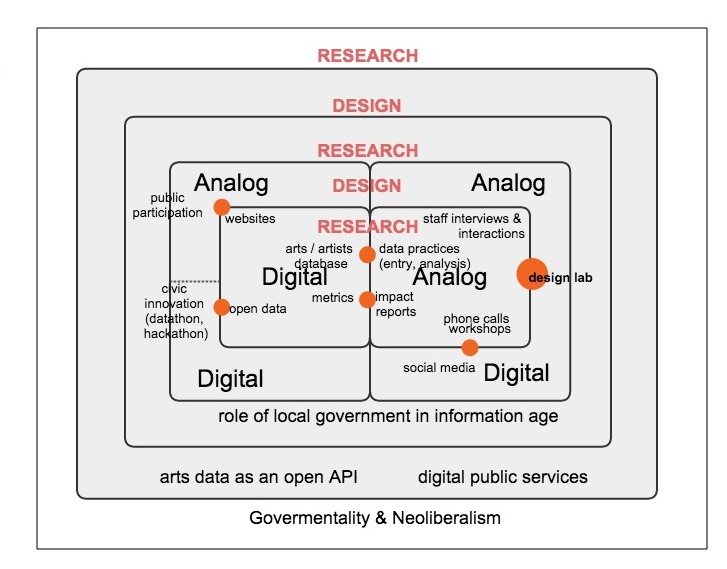
How do ethnographers engage with the changing form of culture as it becomes increasingly mediated by digital technology? This workshop explores emerging digital methods for collecting, analyzing, visualizing, and narrativizing ethnographic materials. In the first hour, I will introduce the utility of digital tools and computational approaches – including webscraping, mapping, and visualization – for ethnographic inquiries. Drawing empirical examples from my research on Asian American musicians’ digital diaspora, the street music-culture in Taiwan, and my research/design work with the City of Los Angeles Department of Cultural Affairs, I will discuss the affordances (and limitations) of the digital extensions of participant-observation. The second hour of the workshop will be a speculative research design lab in which we collectively explore touch points with the digital in the participants’ own research processes and come up with potential research designs.
I introduced some of my new research ideas related to touchpoint, a pivotal point that allows the researcher to theorize and design research methods to interrogate the digital-analog interfacing in contemporary social life. The touchpoint concept is built on Fabian Girardin’s work on friction. Presentation documentation: slides; annotated slides.
The workshop portion of the event provided an interactive co-exploration of digital-analog touchpoints in the participants’ own research projects. The flow of the workshop is guided by questions on this handout.
Additionally, I gave a talk titled “Performing research / researching performance? A multimodal approach to knowledge and creative production” to a group of music industry students. In this talk, I examined the creative intersection between ethnographic research, performance, and arts organizing.
Instead of a physical participation at the Open Access roundtable at the annual meeting of Society of Ethnomusicology (SEM) in Pittsburgh today, I’ve offered my thoughts in the form of an audio recording and a post for Ethnomusicology Review (reblogged by JustPublics@365 out of CUNY). In this post, I traced the lifecycle of two of publishing projects from fieldwork to journal articles and argued for a productive tension between blogging and academic writing.
To sum up the post, I end with the following:
Publishing, to me, in its simplistic sense, is to make something public. If our public precludes those who have been our research associates, or individuals without institutional affiliations or access to scholarly journals, then we should rethink how we communicate our scholarship. Lastly, I return to the question of research impact, an inquiry central to the ethnographic perspective and a critical step of the ethnographic feedback loop. The issue of transparency can set the course of impact of our research. Having an open and transparent channel of communication is the beginning of a meaningful dialogue we ethnomusicologists can foster with the public. Informational openness, however, is a complex discourse that requires further contextualization and its discussion would not complete without a full consideration of access, ethics, and responsibility (Christen 2012). We’re living in a moment where the value of scarcity associated with industrial mode of production (Suoranta and Vadén 2008:131) is being challenged by the dispersed openness afforded by digital media. The scholarly publishing industry itself is a cultural field with policies and infrastructures driven by commercial values (Miller 2012) that mostly defy public interests. We should maintain our critical viewpoints as we engage with our own scholarly communication practices.
For a more personal framing on the meaning of open access publishing for a young off-tenure-track scholar, listen to this short audio recording. It’s kind of a pep talk.
Many people have asked me what I do these day. To respond to a request from my home department at UVa, I wrote a blurb about my job earlier today. I’m sharing it more broadly to show how I’m utilizing my graduate training in music studies (ethnomusicology!) and digital humanities and give visibility to postdoctoral careers outside of the conventional academic path.
——————————————————————————————————————————-
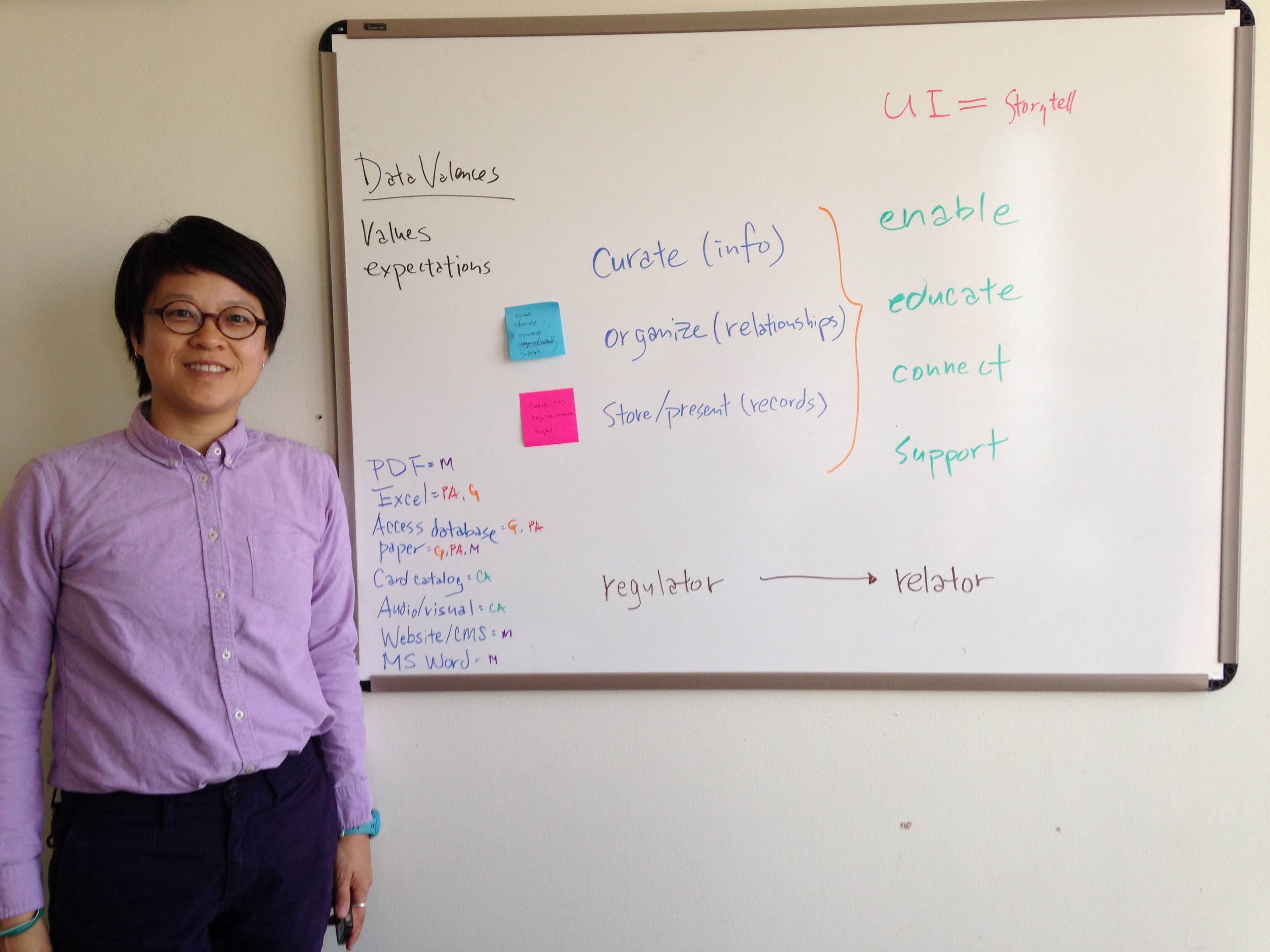
As an ACLS Public Fellow, I work with the City of Los Angeles Department of Cultural Affairs (DCA). I use the phrase “research & design” to encapsulate my role here at DCA. The goal of my fellowship is to help the department augment its digital relevance by developing information systems and resources to increase public engagement and transparency. I hope to contribute to the early efforts of establishing the department as a public cultural broker in the information age, shifting the role of government away from a regulator to an enabler and educator.
At work, I ask prickly questions about the intersection among the arts experience, civic participation, and technology. Combining my training in ethnomusicology and digital humanities, I spend my days making sense of data culture at the city and understanding large amounts of arts and cultural data from various departmental programs. I research innovative forms of information technologies across sectors, keeping abreast of academic and public discourse about the ethics and civil rights concerning information culture. My research produces recommendations for data and information system redesign. I help implement some solutions by generating prototypes for arts data mapping and impact data storytelling, for instance. I also engage in staff education through teaching new methods of research, analysis, and communication including geospatial information system (GIS), digital photo story, and data visualization. My recommendations often speak to social issues related to culture and technology touching on topics such as big data, public-private partnerships, gentrification, and neoliberalism. I strive to make effective procedural and occasionally programmatic recommendations based on my observations and participation of municipal work, as the city government transitions into a new information era.
Within DCA’s divisional structure, I work closely with the Marketing and Development Division. Currently, I’m co-leading the departmental website project with our Assistant General Manager and Communication Director with the goal to design a suite of digital services. To help increase transparency and build trust among our constituents and related stakeholders, I manage social media (@culture_LA) and develop digital communication guidelines, articulating the department’s mission and impact to the public.
Additionally, I serve as the department’s liaison with the Mayor’s Office, consulting and developing inter-departmental projects including the Open Data initiative and the Great Streets program. I interpret Mayor’s requests for data-driven approaches to quantify arts and cultural programming and design possible implementations that are sensitive to the richness and sometimes immeasurability of cultural experiences.
Aside from my work with DCA, I continue to publish my research and lead digital and public scholarship projects including Movable Parts, a socially engaged maker project; and Paperphone, a scholarly audio app funded by Duke’s Franklin Humanities Institute. I also write songs and perform in Bitter Party, a band that reanimates my research findings related to Asian American melancholia and postcolonial wartime musics.
Culture takes variegated forms, including lived experiences, social interactions, memories, rituals, transactions, events, conversations, stories, gestures, and expressive disciplines like music and dance. These processes and artifacts of social life make an ethnographer’s job as analyst and cultural documentarian dynamic and challenging. The increasing digital mediation in the field of ethnographic inquiry is undeniable. Through the engagement of individual users, governments, corporations, and even grassroots organizations, the ubiquity of computational technology has a far-reaching impact on social life. These technologies mediate culture by documenting, sharing, sensing, tagging, locating, trading, synchronizing, filtering, automating, remixing, and mining the everyday experiences of our research associates. Rather than walking away from the digital, we ethnographers should give serious considerations to software as infrastructure and materiality at the sites of our research. We should also be mindful of our own digital research practices as we utilize digital technology to organize, manage, and publish our field findings.
A preview of what my paper delves into:
In this article, I examine how working with a variety of digital tools, including webscraping, mapping, and sound visualization, could widen the scope of ethnographic work and deepen our practice. I stay within the domain of data gathering in part one. In part two, I talk about the process of interpreting field data and the value of geospatial visualizations. The last part explores digital methods that magnify our perception of physical senses like sound, sight, and space. Throughout these discussions, I will also comment on the methodological, and where relevant, the social implications of these approaches.
Finally, I end with the call:
Digital ethnography as I have methodologically reframed is not fundamentally different from traditional ethnography. We have learned much from doing things across the silos of the society and the academy because doing in the form of participation, as opposed to thinking or theorizing alone, is humbling and it pushes the boundaries of our horizons. This multiplicity—in senses, modalities, information sources, languages, categories, data types, and frames of analysis—speaks to a juncture at which technology underlies the change in form and content in our social life. In addition to speculating and theorizing this change, we should heed the praxis axiom of ethnography to open up the black box of ethnographic methodology, so that we can experiment with how we practice, embody, and enact the lessons from the field. Maybe then we can be better informed as we shape the development of technologies that undergird our work.
This paper wouldn’t be possible without the thoughtful feedback from Bethany Nowiskie, Tricia Wang, and JDH editor Stephanie Westcott; and support from the University of Virginia’s Scholars Lab (special shoutout to Joe Gilbert!) and Occidental College’s Center for Digital Learning + Research. I am grateful of you.
For those who are code-curious, I appended the webscraper code to the article.
We built a site to anticipate for our official launch for Paperphone. We have populated the site with tutorial videos and texts, and contextual information about the project. This full site would make our final launch — scheduled on Monday March 17th Wednesday March 19th — more effective and compelling.
Jonathan and I did some development work based on the feedback we got from you the last couple of days. We are releasing a second beta version of Paperphone. [Read about design ideas and background related to Paperphone.] In this version, we improved the user interface, added key controls and fixed presets, and resolved a Windows Runtime issue.
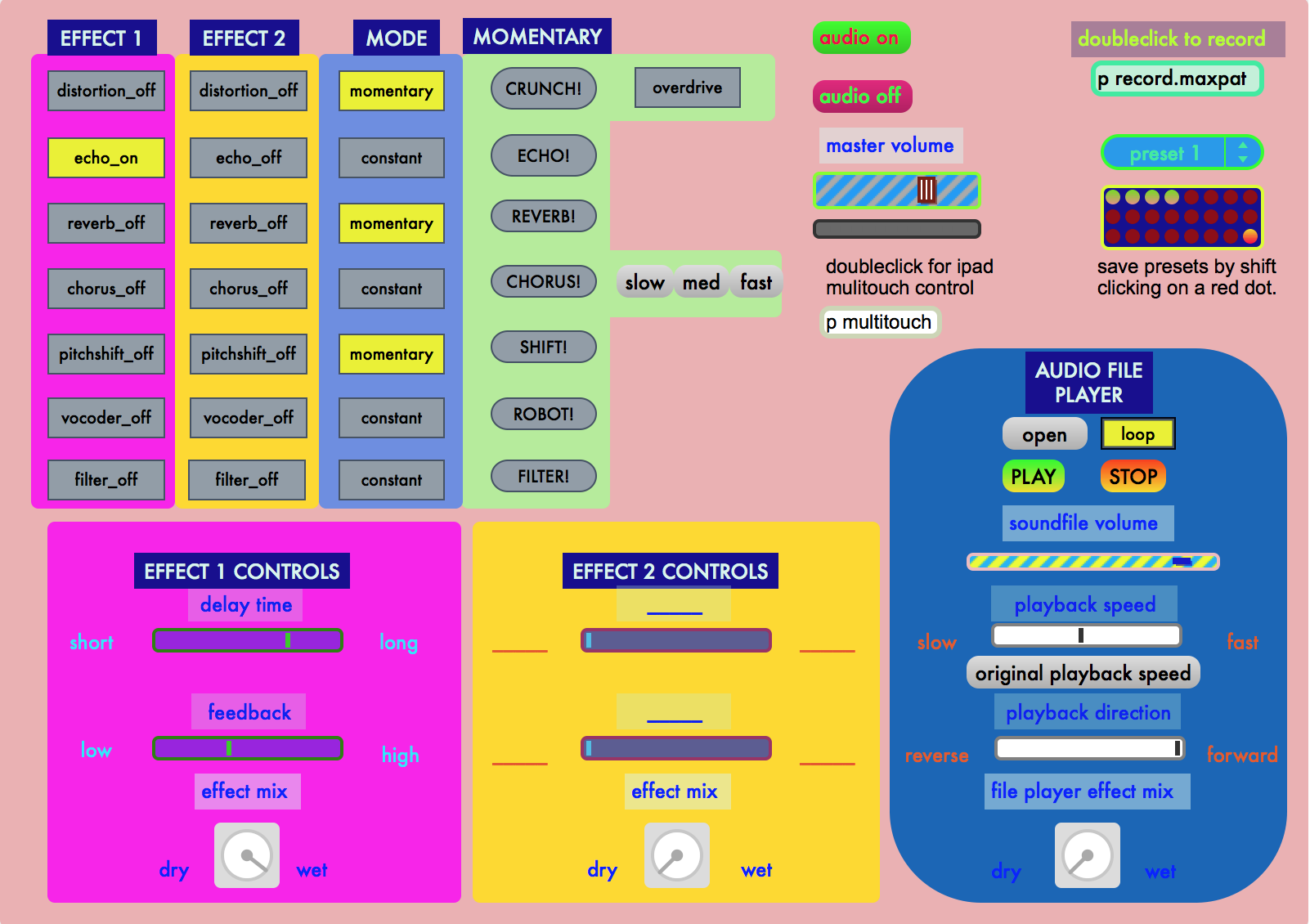
The new interface should be a little more intuitive than the previous one. I took some time to study the GUI (graphic user interface) of Ableton Live and came up with a new wireframe. We moved the master controls to the right edge of the frame, and rotated the volume indicators and controls to be vertical. We also color-coded the presets areas to be purple.
Paperhone: GUI beta2a
With the preset functions, you can now experiment with effect presets that we have designed. These fixed presets include: megaphone, robot, archive, spacey, artifact, intercom. If you have suggestions for effect presets, please send us a screenshot of your settings along with a name suggestion for the preset. We would love to hear about your effect design in terms of sound, concept, and even implementation!
Per our tester Gabriel’s (@SanNuvola) suggestion, we added a feedback feature so that the user can take a live signal from the microphone, and then feed that back into the system to create a loop of “cumulative noises & silence.” Please use with cautions.
Lastly, we added a series of key controls so that the user can control the settings by hitting keys on their computer’s keyboard. For instance, you can click on the first letter of the effect name to turn on/off effect 1 (e.g. click “r” to activate reverb). You can also navigate through the preset menu via the arrow keys on the keyboard. Specific instructions are included in the patch.
System Requirement: Max, or Max Runtime. [If you don’t already have Max on your machine, please download Max Runtime to run the Paperphone patch.]
We value your feedback. If you have time, please respond to the following:
Which of the effects and effect combination are effective, fun, and useful? If you can, please share screenshots of your effect settings (and potential names of your preset configuration).
If you have time, please also help us develop its user experience by describing scenarios in which you would use Paperphone: thinking through the kind of prose + effect combination (which configuration of buttons to activate, how would you configure your presets, how would you navigate the controls throughout a paper, etc).
Does the interface seem intuitive to you? What can we do to improve it?
Jonathan and I are excited to release our first beta version of Paperphone!
Paperphone is a scholarly voice playground. It is a vocal effect processor designed for scholarly papers. Designed to transform the role of the voice in scholarship, the user could apply audio effects (including distortion, reverb, echo, vocoder!, etc) to their voice during live paper presentations. Read about the rationale behind the project.
At this point, we are looking for feedback on its usability. We want to know what you think of the user interface and sound design.
Does the interface seem intuitive to you? What can we do to improve it?
Which of the effects and effect combination are effective, fun, and useful? If you can, please share screenshots of your effect settings (and potential names of your preset configuration).
If you have time, please also help us develop its user experience by describing scenarios in which you would use Paperphone: thinking through the kind of prose + effect combination (which configuration of buttons to activate, how would you configure your presets, how would you navigate the controls throughout a paper, etc).
We would be grateful if you would provide your feedback in the next couple of days, say, by this Monday March 3. Please email me your feedback at wendy dot f dot hsu at gmail.
Paperphone is built in the Max environment. If you don’t already have Max, you can download Max Runtime to run to the patch. Instructions for Paperhpone are included on the app’s interface. If you have Mira, the iPad controller for Max, you could control Paperphone using Mira. There may be bugs in the connection between Mira and Max, however.
W.F. Umi Hsu (pronouns: they/them) writes here to reflect on the intersection among ethnography, civic innovation, and the arts, and on their research of urban sounds and music.





 bio
bio